
To mark International Fraud Awareness Week, G+D shows what makes banknotes so secure – and which features you can check yourself
Munich, November 16, 2026 – A banknote changes hands countless times every day. We put it in our wallet, hand it over at the register, or receive it back as change. What hardly anyone realizes is that every banknote incorporates a sophisticated security concept. It ensures that money remains reliable even after years in circulation and makes life difficult for counterfeiters. To mark International Fraud Awareness Week (November 15–21), the SecurityTech company Giesecke+Devrient (G+D) highlights five features that protect modern banknotes – some of which anyone can easily check for themselves.
What looks like an ordinary banknote at first glance turns out to be a small marvel of security. Its sophisticated and technologically advanced security features are hidden in a wide variety of places: in the paper, on the surface, in special foils and inks, and even in characteristics that only machines can detect. It is only the interplay of these features that makes a banknote secure. But what exactly makes a banknote secure? Some features can be checked without any tools – following the principle that central banks worldwide use to communicate the security of their banknotes: feel, look, tilt.
Banknotes feel different from ordinary paper. This is due to their special material: most currencies worldwide are made from cotton fibers. These so-called substrates are exceptionally durable and also form the basis for additional security features. The surface also contributes to their security. Certain printed areas are raised and can be felt. The distinctive texture is difficult to replicate with ordinary paper, which allows us to detect the first signs of authenticity simply by touching the note with our fingertips.
When you hold a banknote up to the light, it reveals details that remain hidden under normal viewing. The watermark is created during the production of the substrate: areas of varying thickness allow more or less light to pass through, thus forming an image with subtle light-dark gradations. The security thread also becomes visible as a continuous line when held up to the light. On many banknotes, it also features fine negative text – such as the denomination. Both features are firmly embedded in the material and therefore cannot simply be printed on.
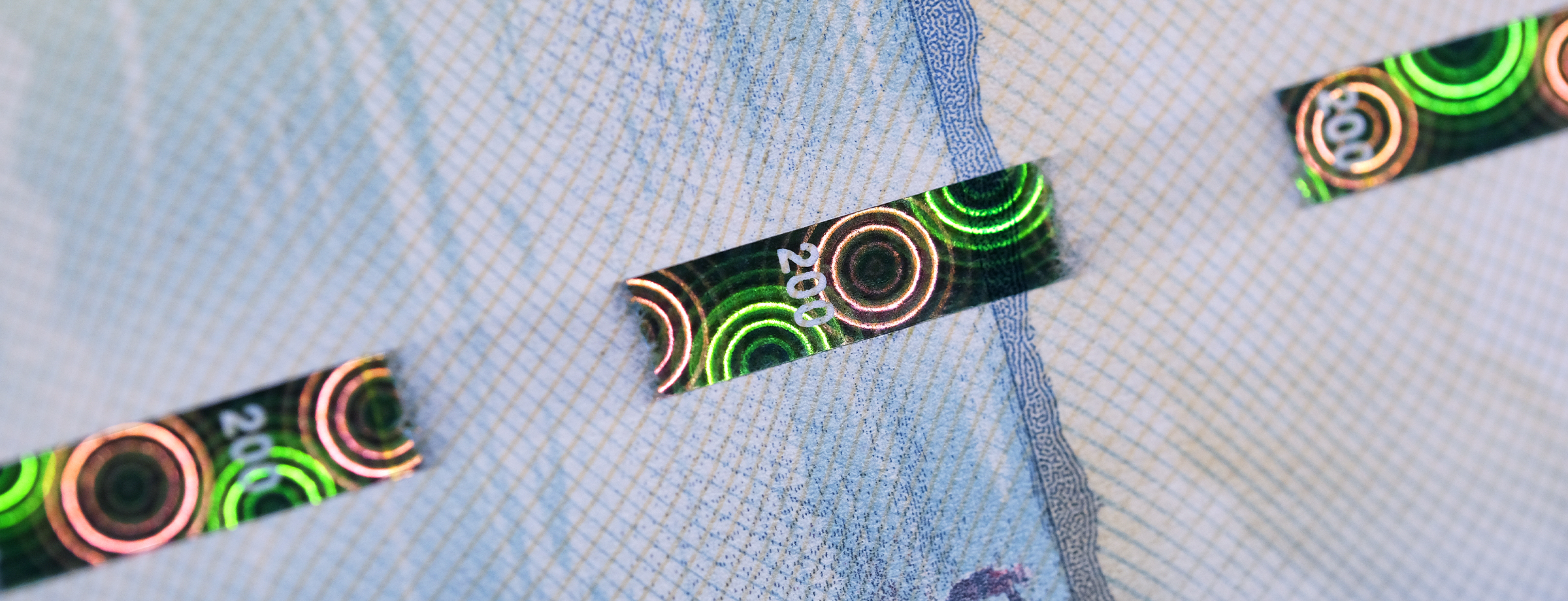
If you tilt a banknote, you’ll see how some elements change: they shift color and display dynamic motion effects. These include optically variable security foils and security threads, as well as special effect inks. Behind these effects lie precise optical structures that reflect light in specific ways. Features with tiny micromirrors and nanostructures are particularly secure and dynamic – up to one million such micromirrors can fit on a single thumbnail.
Not all security features are intended for the human eye. Banknote processing machines and verification devices at commercial banks, central banks, and retail locations use sensors that detect characteristics that remain hidden from us. Special printing inks, for example, glow under UV light or absorb infrared light. Security threads also carry magnetic codes. This allows the authenticity of banknotes to be reliably verified even during the rapid, automated processing of large quantities.
Covert central bank features represent the highest level of security. They can be verified exclusively by central banks using sensors developed specifically for this purpose, and how exactly they work is deliberately kept secret. This allows even very well-made counterfeits to be reliably detected.
“Above all, cash must be reliable in everyday life,” explains Felix Ehrtmann, Product Manager for Integration + Print at G+D Currency Technology. “Consumers can reliably verify the authenticity of a banknote in just a few simple steps. At the same time, retailers and banks must be able to process large volumes of banknotes quickly and securely. This requires multiple layers of security features that complement each other and together provide effective protection against counterfeiting.”
About Giesecke+Devrient
Giesecke+Devrient (G+D) is a global SecurityTech company headquartered in Munich. G+D makes life safer for billions of people. The company builds trust in the digital age with integrated security technologies across three business divisions: Digital Security, Financial Platforms, and Currency Technology.
G+D was founded in 1852 and today employs more than 14,500 people. In fiscal year 2025, the company generated revenue of 3.2 billion euros. G+D is represented by 118 subsidiaries and joint ventures in 41 countries. For more information: www.gi-de.com
Press Contact
Giesecke+Devrient
Christoph Lang
Head of Corporate Brand Communications and Government Relations
Phone: +49 89 4119-2164
Email: christoph.lang@gi-de.com
PR-COM
Jessica Zola
Account Management
Phone: +49 89 59997-815
Email: jessica.zola@pr-com.de
Giesecke+Devrient (G+D) ist ein weltweit tätiges Unternehmen für SecurityTech mit Hauptsitz in München.
Strategische Perspektiven, Branchen-Insights und Kommunikationstrends – kompakt und relevant.
Kein Spam. Jederzeit abbestellbar.