GOOD COMMUNICATION IS A BOON TO SALES
By Christina Haslbeck and Dominik Mohilo
Visibility has always been the primary benchmark for effective corporate communications. It remains important, but with increasing competitive pressure, simply having a market presence is no longer enough. The aim must be to generate greater impact for sales – across all stages of the sales cycle.
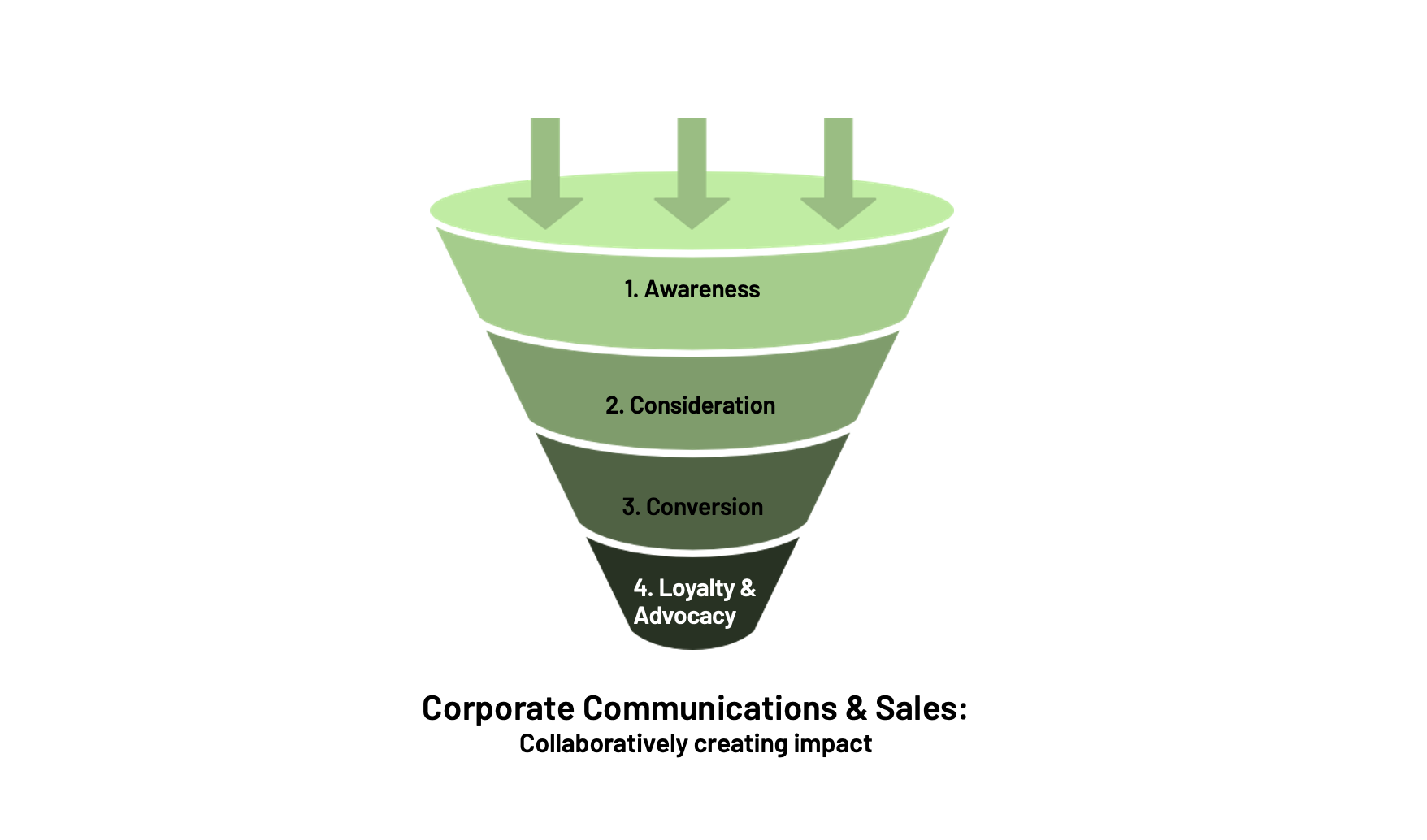
The impact of communication in the sales funnel
To achieve a lasting impact, it is crucial that those responsible for communication work closely with the sales department. The good news is that companies need neither grope in the dark nor resort to digital voodoo to measure the effectiveness of this collaboration. Clear KPIs can be defined for all four phases of the sales cycle – or sales funnel.
Phase 1: Awareness
This early stage of the sales process is all about generating attention and getting noticed by potential customers. To achieve this, companies refine their positioning, demonstrate expertise in their field and build credibility for their own products. At this stage, earned media and paid media are primarily used: specialist articles, participation in events and trade fairs, interviews or podcast discussions, social media posts, B2B and corporate influencer relations, as well as targeted awareness advertising campaigns ensure that target audiences are ‘warmed up’. This means that sales do not start from scratch; instead, the company already has a certain reputation. This builds trust, which is an excellent prerequisite for fruitful sales discussions.
Relevant KPIs at this stage include not only reach, but also:
- High-quality placements in decision-maker and Tier 1 media
- Share of voice within the relevant competitive landscape
- Third-party citations, impressions, reach and click-through rate on social media
- Visits to the website or landing page
- Inbound mentions in sales conversations (“We read your article in trade magazine XY …”)
Phase 2: Consideration
As soon as prospects start comparing options, things get serious. It is precisely at this stage that the impact of corporate communications on sales becomes apparent. One effective way to encourage a positive outcome is to provide case studies, specific use cases, infographics and technical articles. Roundtable events for decision-makers, as well as webinars and other lead generation campaigns featuring special lead magnets that address the potential customer’s pain points and offer initial concrete assistance or solution options, ensure an even deeper and more interactive influence on the purchasing decision. The focus is on presenting solutions to complex problems in a way that is understandable and transparent. Good content builds trust among decision-makers and provides sales managers with selling points that they can then leverage in direct customer contact. It is at this stage that the real business impact of communication begins, as it makes the sales department more confident and efficient. This can be measured by:
- Leads, CPL (cost per lead)
- Downloads (e.g. white papers, case studies)
- Webinar registrations and attendance
- Active use of communication content and tools by the sales team
- Shorter explanation phases during the pitch
Phase 3: Conversion
The final phase is, so to speak, the last hurdle in the sales process. Potential customers do not want to take any risks and are looking for reassurance. Testimonials, media coverage of the company and strong endorsements from within the industry provide the necessary validation. Effective communication enhances the company’s credibility, puts price discussions into perspective and positively influences the customer’s decision-making process. The KPIs in this phase are the conversion rate and the communication ROI:
- CR (Conversion Rate)
- ROAS (Return on Ad Spend)
- CAC (Customer Acquisition Cost)
4. Phase: Loyalty und Advocacy
Der Sales Funnel endet nicht mit dem Verkauf, denn Unternehmen müssen gewonnene Kunden auch halten. Thought-Leadership-Kampagnen, eine gute Krisenprävention und – im Falle eines Falles – auch das Krisenmanagement sowie ein stetes Community-Management helfen dabei. All diese Efforts sind für den Vertrieb wichtig, da sie nicht nur Bestandskunden, sondern auch potenziellen Neukunden zeigen: wir sind präsent und kümmern uns um euch. Gleichzeitig sind Referenzen im Vertriebsprozess ein wichtiges Asset und so geht es in der letzten Phase des Sales Funnel auch darum, weitere zu erhalten. Im Idealfall transformieren Kunden am Ende selbst zu Botschaftern und sind zum beidseitigen Gewinn bereit, an Case Studies mitzuwirken, Zitate und Empfehlungen zu liefern oder für Inhalte wie Podcasts als Testimonials zu kollaborieren. However, the sales department should also be aware that recommendations are not a matter of chance, but the result of strategically guided communication. KPIs relating to loyalty include the customer retention rate and the repeat purchase rate. For advocacy, engagement rates and user-generated content (particularly on social media), newsletter open rates, and the number of recommendations, case studies and co-interviews are of interest.
Mere visibility versus genuine business impact
A detailed examination of all stages of the sales funnel demonstrates that communication has an enormous impact on business success. This requires close collaboration between sales, marketing and communications, as well as all other departments within the company, including senior management. And, of course, a public relations strategy in which content is ideally aligned with the company’s products on the one hand, and the interests or pain points of potential customers on the other. However, as companies are often ‘trapped’ in certain patterns, it is often helpful to rely on external communications agencies to develop the most sensible course of action and a suitable content strategy that brings together all departments, products and objectives. It is precisely this close integration that marks the difference between mere visibility and genuine business impact.